
Building Unshakeable Self-Confidence: Affirmations That Transform Your Self-Image
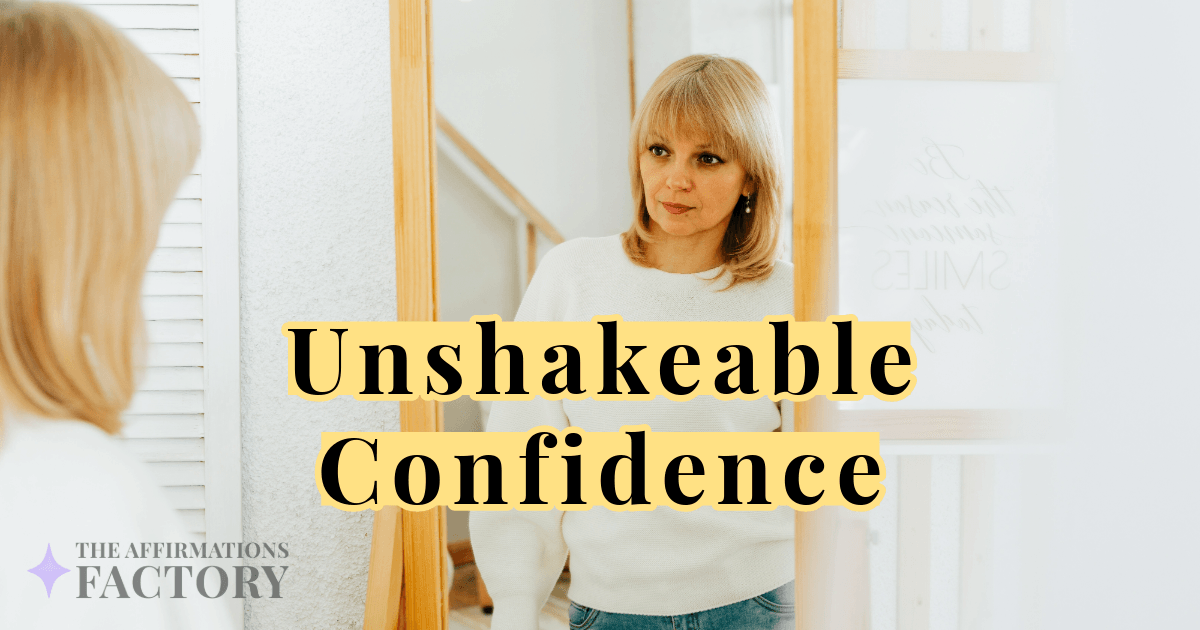
Have you ever watched someone walk into a room with such natural confidence that it seemed like they were born with it? That unshakeable self-assurance that draws others in and makes even challenging situations look effortless?
The truth is, confidence like that rarely comes naturally. It’s built—deliberately and consistently—through practices that transform how we see ourselves at the deepest level.
As someone who spent years struggling with self-doubt before discovering the transformative power of targeted affirmations, I’ve experienced firsthand how our self-image shapes our reality. When we change the lens through which we view ourselves, everything else changes, too.
In this guide, I’ll share the most powerful self-confidence affirmations I’ve discovered, explain the science behind why they work, and provide practical strategies for using them to build unshakeable confidence that withstands life’s inevitable challenges.
The Science Behind Self-Confidence Affirmations
Before diving into specific affirmations, let’s understand why they’re so effective at transforming self-image:
How Self-Image Shapes Confidence
Your self-image—the mental picture you hold of yourself—functions like an internal operating system that influences every aspect of your life. When this mental image is limited or negative, it creates an invisible ceiling on your confidence and capabilities.
According to research published in Psychology Today, we subconsciously act in ways that align with our self-image, even when those actions don’t serve us. This explains why simply “trying harder” often fails to build lasting confidence—we’re working against our own internal programming.
Neuroplasticity: Rewiring Your Brain for Confidence
The good news is that your brain is remarkably adaptable. Through neuroplasticity—your brain’s ability to form new neural connections throughout life—you can literally rewire your thought patterns to support greater confidence.
Research from the National Institutes of Health shows that self-affirmations activate brain regions associated with positive valuation and self-related processing, particularly the ventral striatum and medial prefrontal cortex. This activation creates new neural pathways that support a more confident self-image.
Beyond Positive Thinking: Why Affirmations Actually Work
Affirmations aren’t just about “thinking positive”—they’re strategic tools for cognitive restructuring. When practiced consistently, they help bridge the gap between your current self-image and your desired self-image by making the new identity feel increasingly familiar and authentic.
A meta-analysis of 129 studies with over 17,700 participants, cited by the American Psychological Association, found that self-affirmations produce significant improvements in self-perception and general well-being, with effects lasting for weeks after the initial practice.
35 Powerful Self-Confidence Affirmations
I’ve organized these affirmations into seven categories to address different aspects of building unshakeable confidence. Choose the ones that resonate most with your current challenges:
For Embracing Your Authentic Self
- I am comfortable being exactly who I am, without apology or explanation.
- My authentic self is my greatest asset and source of power.
- I release the need to prove myself to others.
- I trust my own voice and perspective, even when they differ from others’.
- My uniqueness is my strength, not something to hide or diminish.
For Overcoming Self-Doubt
- I replace self-doubt with self-trust and move forward with confidence.
- I am capable of handling whatever challenges come my way.
- My past does not define my capabilities or my future.
- I release perfectionism and embrace growth through action.
- Each time I face my fears, my confidence grows stronger.
For Building Social Confidence
- I communicate with clarity and confidence in all interactions.
- I am worthy of being seen and heard in any group.
- I connect easily with others, being both authentic and approachable.
- I contribute valuable insights and perspectives to conversations.
- I am comfortable setting healthy boundaries in all relationships.
For Professional Confidence
- I bring unique skills and perspectives that add value in any professional setting.
- I am confident in my ability to learn and master new skills.
- I speak up for my ideas and advocate for myself with conviction.
- I handle challenges and setbacks with resilience and creative problem-solving.
- I am worthy of success and capable of achieving my professional goals.
For Body Confidence
- I appreciate my body for its strength, capabilities, and uniqueness.
- I carry myself with confidence, regardless of appearance or others’ opinions.
- I honor my body through self-care that makes me feel strong and vibrant.
- I focus on how I feel in my body rather than how it looks.
- My presence is powerful, and I take up space unapologetically.
For Decision-Making Confidence
- I trust my judgment and make decisions with clarity and conviction.
- I am confident in my ability to make choices aligned with my values.
- I gather information thoughtfully but don’t get paralyzed by analysis.
- I learn from all decisions, whether they lead to success or valuable lessons.
- I stand firmly behind my decisions once made, without second-guessing.
For Resilient Confidence
- My confidence comes from within and remains steady despite external circumstances.
- I bounce back from setbacks with greater wisdom and determination.
- Criticism and rejection are growth opportunities, not reflections of my worth.
- I maintain self-belief even when facing uncertainty or challenges.
- Each challenge I overcome strengthens my unshakeable core of confidence.
How to Implement Self-Confidence Affirmations Effectively
Having powerful affirmations is just the beginning. Here’s how to integrate them into your life for maximum impact:
1. Identify Your Confidence Gaps
Start by identifying specific situations where your confidence wavers:
- Speaking up in meetings or social gatherings
- Making important decisions
- Trying new skills or activities
- Setting boundaries with others
- Handling criticism or rejection
According to Wellness Now Pure, identifying specific confidence gaps allows for a tailored approach rather than generic solutions. Select affirmations that directly address your particular challenges.
2. Create a Morning Confidence Ritual
Your brain is most receptive to new programming within the first 30 minutes after waking. Create a simple morning ritual:
- Find a quiet space where you won’t be interrupted.
- Take three deep breaths to center yourself.
- Stand in a confident posture (shoulders back, head high).
- Speak 3-5 of your chosen affirmations aloud while maintaining eye contact with yourself in a mirror.
- Visualize yourself embodying these affirmations throughout your day.
This practice takes just 5-10 minutes but sets a powerful foundation for confident thoughts and actions.
3. Use Pattern Interruption for Negative Self-Talk
When you notice your confidence wavering, use pattern interruption:
- Pause and take a breath
- Name the self-doubt: “I’m having the thought that I’m not good enough for this opportunity”
- Create distance: “This is a habitual thought, not a fact about my capabilities”
- Replace with an affirmation that directly counters this specific doubt
This practice helps replace limiting beliefs with empowering ones, transforming negative self-talk into supportive inner dialogue.
4. Embody Your Affirmations Physically
Confidence is as much physical as mental. Enhance your affirmations by:
- Adopting power poses while reciting them (hands on hips, arms spread wide, etc.)
- Using confident gestures and facial expressions
- Speaking in a clear, steady voice
- Maintaining good posture throughout the day
Research from Harvard Business School shows that these “power poses” actually change your body chemistry, increasing testosterone and decreasing cortisol, which biologically supports greater confidence.
5. Create Evidence Files
Our brains respond to evidence. Create a digital or physical folder where you collect:
- Compliments and positive feedback you’ve received
- Challenges you’ve overcome successfully
- Skills you’ve developed or improved
- Moments when you displayed confidence
Review this evidence regularly, especially before situations that typically trigger self-doubt. This practice reinforces your affirmations with concrete proof of your capabilities.
Addressing Common Challenges
Even with the best intentions, you may encounter obstacles in your confidence-building journey:
“Affirmations feel false or forced.”
Solution: If affirmations feel inauthentic, try “bridge affirmations” that acknowledge your current feelings while pointing toward greater confidence.
Instead of: “I am completely confident in all social situations.” Try: “I am developing greater social confidence with each interaction” or “I am learning to trust my social abilities more each day.”
“I believe the affirmations intellectually, but don’t feel them emotionally.”
Solution: According to The Power Ark, effective confidence building must address deeper subconscious programming rather than just surface-level thoughts. Try these approaches:
- Pair affirmations with emotional visualization, imagining how it feels to embody this confidence
- Use physical anchors, like placing a hand on your heart while speaking affirmations
- Record affirmations in your own voice and listen with eyes closed, focusing on the emotional resonance
“My confidence improves, but then crashes when I face setbacks.”
Solution: This is where resilient confidence affirmations become crucial. Prepare for inevitable setbacks by:
- Creating specific affirmations for handling criticism, rejection, or failure
- Practicing these affirmations regularly, not just when facing challenges
- Developing a “setback protocol”—specific steps to take when your confidence is tested
Real-Life Transformation Stories
These aren’t just theoretical concepts—they’ve transformed real people’s lives:
Sarah’s Story: After years of staying silent in meetings despite having valuable insights, Sarah began using the affirmation “I communicate with clarity and confidence in all interactions.” Initially, it felt forced, so she modified it to “I am developing my voice and sharing my perspectives more each day.” She paired this with a physical anchor—touching her thumb and forefinger together before speaking—and gradually began contributing more in meetings. Six months later, she was recognized for her leadership and innovative thinking, qualities that had always been present but previously hidden by self-doubt.
Michael’s Story: As someone who struggled with social anxiety, Michael used the affirmation “I connect easily with others, being both authentic and approachable.” He created an evidence file on his phone where he recorded positive social interactions, however small. This combination of affirmation and evidence-gathering helped him recognize his social strengths rather than focusing exclusively on awkward moments. Within a year, he had developed a rich social circle and even took on a leadership role in a community organization—something previously unimaginable.
Aisha’s Story: Facing a career transition that required learning entirely new skills, Aisha combated imposter syndrome with the affirmation “I am confident in my ability to learn and master new skills.” She created a morning ritual where she recited this affirmation while visualizing herself successfully applying these new skills. When self-doubt emerged, she used pattern interruption to replace thoughts of inadequacy with her affirmation. This practice gave her the confidence to persist through the learning curve and ultimately excel in her new role.
The Journey to Unshakeable Confidence
Building unshakeable confidence is a journey, not a destination. This journey typically unfolds through several stages:
Stage 1: Awareness
You begin noticing how your current self-image limits your confidence and creates self-doubt. This awareness creates space to respond differently.
Stage 2: Intentional Reprogramming
You actively practice affirmations and other confidence-building techniques, deliberately replacing limiting beliefs with empowering ones. This stage requires conscious effort and consistency.
Stage 3: Integration
New confidence-supporting beliefs begin to feel more natural and automatic. Self-doubt still arises, but no longer dominates your thinking or behavior.
Stage 4: Embodiment
Confidence becomes an integral part of your identity—not something you do but something you are. Your self-image has fundamentally transformed, creating a stable foundation that withstands challenges.
Remember that this journey isn’t linear—you’ll likely move back and forth between stages depending on circumstances, stress levels, and the specific challenges you face. That’s completely normal and part of the process.
A 7-Day Confidence-Building Challenge
Ready to experience the power of confidence-building affirmations? Try this 7-day challenge:
Day 1: Self-Awareness
- Morning affirmation: I am becoming increasingly aware of my unique strengths and capabilities.
- Evening reflection: Note three strengths you demonstrated today, however subtle.
Day 2: Authentic Expression
- Morning affirmation: I am comfortable being exactly who I am, without apology or explanation.
- Evening reflection: Identify one way you expressed your authentic self today.
Day 3: Self-Trust
- Morning affirmation: I trust my judgment and make decisions with clarity and conviction.
- Evening reflection: Acknowledge one decision you made confidently today, regardless of the outcome.
Day 4: Resilience
- Morning affirmation: Each challenge I overcome strengthens my unshakeable core of confidence.
- Evening reflection: Reflect on how you handled a challenge or setback today.
Day 5: Social Confidence
- Morning affirmation: I am worthy of being seen and heard in any group.
- Evening reflection: Note one instance where you expressed yourself in a social or group setting.
Day 6: Body Confidence
- Morning affirmation: I carry myself with confidence, regardless of appearance or others’ opinions.
- Evening reflection: Observe how your physical presence felt different today.
Day 7: Integration
- Morning affirmation: My confidence comes from within and remains steady despite external circumstances.
- Evening reflection: Review your week and identify which affirmations had the greatest impact.
After completing the 7-day challenge, review your reflections to identify which affirmations resonated most strongly, then create your personalized ongoing practice.
Your Next Steps: From Self-Doubt to Unshakeable Confidence
Building unshakeable confidence through affirmations isn’t about denying challenges or pretending to be someone you’re not—it’s about recognizing and embracing your inherent worth and capabilities. As research from Mental Health America confirms, consistent practice of affirmations creates new neural pathways that support a more confident self-image.
Start your journey with these simple steps:
- Choose three affirmations that address your specific confidence challenges
- Create a simple morning ritual to practice these affirmations daily
- Identify your confidence triggers and prepare affirmations for these situations
- Build an evidence file to reinforce your growing confidence
- Practice physical embodiment of confidence throughout your day
Remember that building confidence is a process, not an event. There will be days when you feel invincible and days when self-doubt creeps back in. Both experiences are valid parts of the journey.
The goal isn’t to eliminate self-doubt—it’s to develop a core of unshakeable confidence that allows you to move forward despite doubts. Each time you choose confident action over hesitation, you strengthen this core.
Which self-confidence affirmation resonates most strongly with you? Share in the comments below, and let’s support each other in building the unshakeable confidence that transforms not just how we see ourselves, but how we show up in the world.